
The Future of Legal Automation with AI Legal Agent: DeepSeek vs. OpenAI and AWS

Introduction
Law firms face increasing complexity in managing case files, legal research, and compliance tracking while ensuring accuracy, speed, and security. Traditional legal workflows—characterized by manual document handling, case law analysis, and deadline tracking—are slow, labor-intensive, and prone to errors.
This article explores why AWS AI is the best choice over OpenAI for legal automation and examines emerging AI disruptors like DeepSeek, which could reshape the legal AI landscape.
Challenges: Inefficiencies in Traditional Legal Workflows
Legal professionals spend countless hours on repetitive, time-consuming tasks:
- Manual document filing and submission leads to delays and increased administrative burden.
- Legal research and case law analysis require significant effort, making it difficult to stay updated on new precedents.
- Deadline tracking and compliance management rely on human oversight, increasing the risk of missed deadlines.
- Confidential data handling demands high security and compliance with industry regulations.
To stay competitive, law firms need AI-driven automation that can:
- Automate legal document creation and filing.
- Analyze case law and extract relevant legal precedents.
- Track compliance deadlines and manage case workflows efficiently.
- Ensure privacy and security of sensitive legal data.
Solution: AI Legal Agent – Transforming Legal Workflows with AWS AI
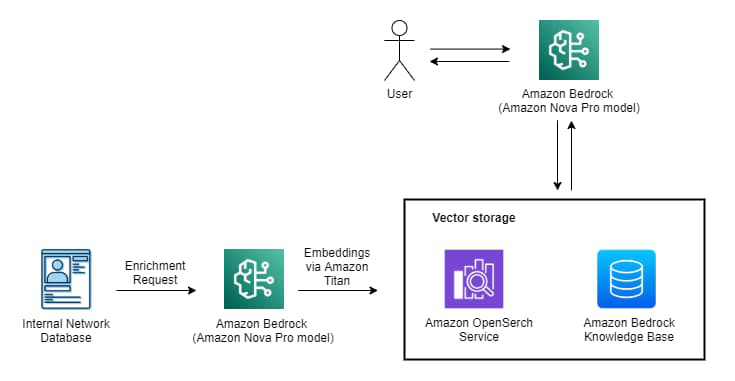
To address these challenges, PropTechVision Inc. developed AI Legal Agent, a fully integrated AI-powered solution for automating legal documentation, case research, and compliance tracking.
How It Works
AI Legal Agent utilizes Retrieval-Augmented Generation (RAG) and vector search to:
- Automate legal document generation – AI drafts legal filings, ensuring they meet court requirements.
- Enhance case law research – AI quickly retrieves and analyzes relevant precedents.
- Generate legal insights and strategic recommendations – AI provides suggested actions based on case history.
- Monitor deadlines and compliance requirements – AI sends alerts for upcoming legal deadlines.
By integrating AWS AI models, AI Legal Agent offers a secure, cost-efficient, and scalable legal automation solution.
AWS vs. OpenAI: Which AI Model is Best for Law Firms?
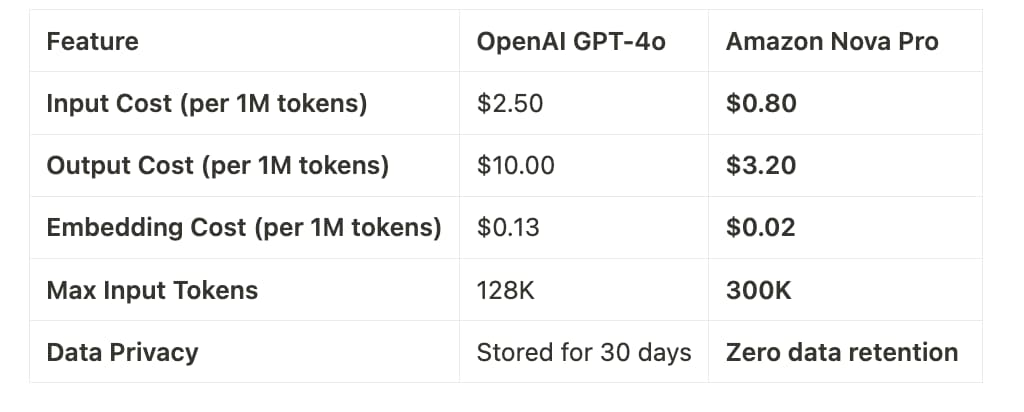
We initially tested OpenAI’s GPT-4o and Text-embedding-3-large but faced significant limitations in cost and data privacy. Here’s what we found when we compared OpenAI and AWS AI for legal automation:
Key Takeaways
- Amazon Nova Pro reduced AI processing costs by 68%.
- Amazon Titan Embeddings V2 cut embedding costs by 85%.
- Amazon Bedrock lets customers turn on zero data retention for models that allow it, while OpenAI keeps API abuse monitoring logs for up to 30 days by default and offers zero data retention to eligible customers it approves.
For law firms handling confidential legal documents and sensitive client data, we recommend AWS AI for its cost efficiency, scalability, and data controls, configured as described below.
Privacy & Security: Data Controls at OpenAI, DeepSeek and AWS Bedrock
Law firms must comply with strict data privacy regulations, making data security a top priority when choosing an AI provider.
OpenAI API: Privacy Considerations
- Data retention: by default, OpenAI keeps API abuse monitoring logs, which can contain prompts and responses, for up to 30 days, unless longer retention is required by law or needed to prevent harm. Eligible customers that OpenAI approves for Zero Data Retention have their content excluded from these logs, though some endpoints and features may still store data.
- Metadata collection: OpenAI gathers usage metadata, even if business data isn’t directly stored.
- Limited access control: OpenAI API data may be reviewed by OpenAI engineers and contractors.
- Model training: Since March 1, 2023, OpenAI has not used API data to train its models by default; the same default applies to its business plans, but not to ChatGPT for individuals. Only data a customer explicitly opts in to share, for example through feedback, may be used for training.
DeepSeek: Privacy Considerations
- DeepSeek collects and stores user data when used via its official API.
- User input, prompts, uploaded files, and chat history may be stored and analyzed.
- Personal information (e.g., email, phone number, account details) is collected.
When DeepSeek models are used through Amazon Bedrock, Amazon Bedrock data handling applies: AWS states that prompts and outputs are not shared with model providers such as DeepSeek, and that model providers have no access to Amazon Bedrock logs.
Source: DeepSeek Privacy Policy
AWS Bedrock: Privacy Considerations
- Data retention: customers can set a data retention mode for their account in each AWS Region, or for a project. In zero data retention mode, AWS writes no prompts or outputs to durable storage and shares none with the model provider. Otherwise each model’s own policy applies, and some models require AWS to keep some or all prompts and outputs for abuse detection, for example for up to 30 days, without sharing them with the model provider. Amazon Bedrock blocks those models in zero data retention mode unless the account is approved for zero data retention on that model.
- No model training on customer data: AWS and third-party model providers do not use Amazon Bedrock inputs or outputs to train Amazon Nova, Amazon Titan, or third-party models. OpenAI’s API has a similar default, described above.
- Access control: Amazon Bedrock uses a zero operator access model, apart from the abuse detection cases that AWS documents, in which it may store or review content. Model providers have no access to Amazon Bedrock logs or to customer prompts and completions. Under the AWS shared responsibility model, the law firm is responsible for its own access settings, such as IAM permissions and multi-factor authentication.
Bottom Line: For law firms dealing with confidential case data, we recommend Amazon Bedrock, provided the firm turns on zero data retention, uses models that allow it, restricts access with IAM, and checks each model’s current terms. No provider can guarantee full privacy: the result depends on how the service is configured and used.
AWS DeepSeek Pricing: A Low-Cost Future Option?
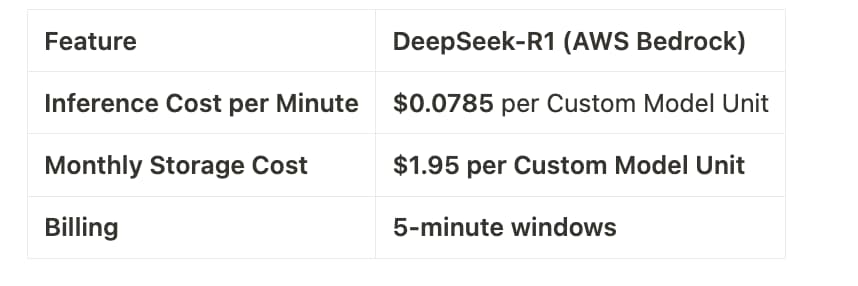
DeepSeek, available via AWS Bedrock, offers competitive pricing for AI inference:
Example: A custom Llama 3.1 model (8B parameters, 128K sequence length) requires 2 Custom Model Units.
Estimated cost: $0.157 per minute and $3.90 per month for storage.
DeepSeek on AWS could provide a lower-cost alternative for firms seeking AI-powered legal automation.
Future Prospects: Could DeepSeek Disrupt the Legal AI Market?
The rise of DeepSeek, a Chinese AI startup, has introduced a new wave of cost-efficient, open-source AI models that could disrupt the legal AI landscape.
- Efficient architectures (Multi-Head Latent Attention & Mixture of Experts) to reduce computing costs.
- Open-source AI models, allowing law firms to customize AI workflows.
- Industry-specific AI, potentially optimizing legal document processing, compliance automation, and legal research.
Should Law Firms Consider DeepSeek?
For now, AWS remains the leading choice for enterprise legal AI due to scalability, security, and enterprise-grade AI performance. However, as DeepSeek and similar disruptors evolve, law firms may explore:
- Multi-LLM Strategies – Using AWS AI for compliance and security while leveraging DeepSeek for cost-effective case research.
- In-house AI Development – Building custom legal AI models with open-source DeepSeek LLMs.
- Cost Optimization – Reducing reliance on premium LLMs without compromising legal accuracy and efficiency.
While DeepSeek is not yet a direct competitor to AWS for enterprise-level AI, its affordable, efficient models signal a potential shift in the legal AI market. Law firms should stay agile and open to future AI innovations.
Conclusion: AI is the Future of Legal Practice
With AWS AI, PropTechVision Inc. is transforming how law firms handle legal documentation, case research, and compliance automation.
AI Legal Agent automates legal workflows, saving time and reducing errors.
We recommend AWS AI over OpenAI for cost savings and, with its data controls configured as described above, for data security.
Emerging AI disruptors like DeepSeek could shape the future of legal automation.
Your Project, Our Expertise.
Tell us what you’re working on, and we’ll craft a solution that makes your business run better.
